IELTS Result Check: Turn Scores Into Diagnostic Strategy

Treat your IELTS result check as diagnostic data. Learn to map band scores against official criteria to fix specific failures before your next retake.

2026-09-20

Logging into the candidate portal for your IELTS result check is usually an emotional event, defined by a single number. For high-stakes applicants, that number is a lagging indicator, nothing more. It confirms where you stood on test day. It says nothing about the specific mechanical failures that kept you from your target band. Treating this notification as the final word on your ability is a strategic error, and it's the error that leads straight to expensive, unproductive retakes. Reframe the moment you get your scores as the start of a diagnostic cycle, one that isolates variables instead of celebrating or mourning outcomes.

Turning an IELTS Result Check Into a Diagnostic Strategy

A standard IELTS result check gives you a macro-level outcome. It does not give you the granular data you need to engineer a different result next time. This platform does not replace the official Test Report Form or guarantee visa approval; only authorized testing bodies can issue legally valid documentation for immigration or university admissions. What a diagnostic approach does instead is convert a static band score into a set of variables you can address before your next sitting. Skip that translation step, and you're simply hoping more practice tests will fix structural problems that have already resisted casual study.

Take the case of a skilled migration applicant, a nurse or engineer, who scores Writing Band 6.5 despite hitting 7.0 or higher in Listening, Reading, and Speaking. The first reaction is usually confusion, followed by the assumption that they had a bad day or drew a strict examiner. But run that same IELTS result check against the official band score criteria and a different pattern shows up, one that generic preparation won't touch.

Pricing

Free → $15 confirm → then fix what matters

Free band estimate on this page. $15 Reality Check confirms your four-skill diagnosis. Then Skill Fix ($29/mo) or Complete ($49/mo). 7-day refund on first charge.

Fix one skill · $29/mo

$29/mo — train the skill that caps your band

  • Listening, Reading, Writing, or Speaking — one skill
  • Exam-format mock + AI IELTS feedback
  • Retake until you improve
Fix one skill

Fix all four skills · $49/mo

$49/mo

  • Unlimited Listening, Reading, Writing, Speaking mocks
  • Save $67 vs 4 Skill Fixes
  • Cancel renewal anytime in Stripe
See Complete — $49/mo

Why most students keep retaking

Listening. You hear it once. Miss it → lose marks instantly. IELTS listening practice

Reading. Most fail because they run out of time. IELTS reading practice

Writing. One weak area caps your entire score. IELTS writing feedback

Speaking. You freeze or give short answers under pressure. IELTS speaking practice

A nursing applicant who needs Band 7.0+ in each component often finds, through detailed descriptor analysis, that their Writing Task Response keeps landing at Band 6 because the ideas aren't developed enough, despite strong vocabulary. They might be deploying sophisticated lexical resources and complex grammar, but they never fully extend and support their main ideas with specific examples, which is exactly what the Band 7 descriptor asks for. The official result just says "6.5." It hides the fact that the deficit sits entirely in one sub-criterion, while three other areas already clear the target.

This matters because retaking the test without fixing that specific Task Response failure produces the same score, indefinitely. Most candidates in this spot book another exam right away, on the theory that familiarity with the test format will lift the writing score on its own. It won't. Repeated exposure to the same prompt types just reinforces bad habits when the underlying assessment criteria stay misunderstood. Cross-reference your result against the public band descriptors and find out whether the weakness sits in coherence, lexical resource, grammatical range, or task achievement. That mapping turns the passive act of checking results into an active remediation plan aimed at the exact mechanism of failure. For high-stakes candidates in 2026, the period right after your result needs rubric-aligned analysis, not passive waiting or vague content review.

A common misconception: a general English tutor will fix these plateau issues. Most language instructors have no specialized training in IELTS assessment matrices. They can correct grammar and suggest better vocabulary, but they routinely miss the line between a Band 6 and a Band 7 in Task Response, because that line is evaluative, not linguistic. Score improvement begins when candidates map their performance against the four specific assessment criteria, not when they chase general language enhancement. If your IELTS result check shows a persistent gap in Writing, figure out whether the problem is linguistic competence or assessment literacy. Plenty of capable professionals have excellent English but never structure their responses to match the examiner's expectations, which is why the fix for Band 6 writing plateaus takes targeted intervention, not broader study.

Treating your score as diagnostic data also kills the guesswork that drains motivation during prep. Instead of wondering vaguely how to improve, you have a specific hypothesis to test: extending main ideas with concrete examples should raise Task Response from Band 6 to Band 7. That shifts your preparation from passively consuming tips to actively experimenting with measurable outcomes. Every practice session becomes a check on your diagnostic findings, which makes your study time far more efficient. Successful retakers separate themselves not through raw talent but through sharper post-result analysis, the kind that turns disappointment into engineering specifications.

Official Release Timelines and Verification Protocols

Understanding how result delivery actually works prevents unnecessary anxiety, and it stops you from mistaking a preliminary preview for a legally binding document. Computer-delivered IELTS results are typically released within 3 to 5 days after the test date in 2026, while paper-based results take approximately 13 days. These timelines hold across testing centers globally, though occasional delays happen during peak periods or after system maintenance. Plan your application deadlines around these known windows instead of hoping for early release; testing bodies stick to published schedules to protect security protocols. Knowing exactly when to expect your IELTS result check lets you schedule diagnostic analysis sessions in advance, so you keep momentum instead of losing weeks to uncertain waiting.

The online preview in the candidate portal is an informational courtesy. It has no legal validity for immigration applications or university enrollment. Only the physical Test Report Form, mailed to your registered address or available for collection at designated centers, counts as official proof of your English proficiency. Universities and immigration authorities will never accept screenshots or portal printouts as evidence, however authentic they look. This causes real problems for applicants who submit online previews to meet urgent deadlines, only to have their applications rejected or delayed pending the official form. Verify institutional requirements before submitting anything other than the original Test Report Form, and factor in postal delivery times if you're applying from outside the test center's country.

The Enquiry on Results (EOR) process exists for candidates who believe their score contains a clerical error, but it's a secondary measure next to proactive skill diagnosis. You can request a remark within six weeks of your test date, paying a fee that gets refunded only if your band score goes up. Successful EORs do happen, but they're statistically rare and typically involve borderline cases where human judgment varied slightly between examiners. Leaning on an EOR as your primary strategy for hitting a target band is inefficient next to diagnosing and correcting the actual performance gaps your initial IELTS result check revealed. Use the EOR process when you have strong external evidence of a marking anomaly: consistent mock scores well above your official result, combined with detailed feedback from qualified assessors confirming your performance met higher band descriptors.

For most high-yield candidates, the time spent waiting on an EOR outcome is lost preparation time. That six-week processing window could go toward fixing identified weaknesses through targeted practice, validated by instant AI evaluation built to mirror official marking standards. Administrative appeals address past errors. Diagnostic preparation prevents future ones. After checking your results, your energy should go toward understanding your performance patterns, not contesting them, unless you have compelling evidence of a procedural failure. The verification protocols exist to keep things fair, but your real lever for score improvement is still your own targeted response to the data in front of you.
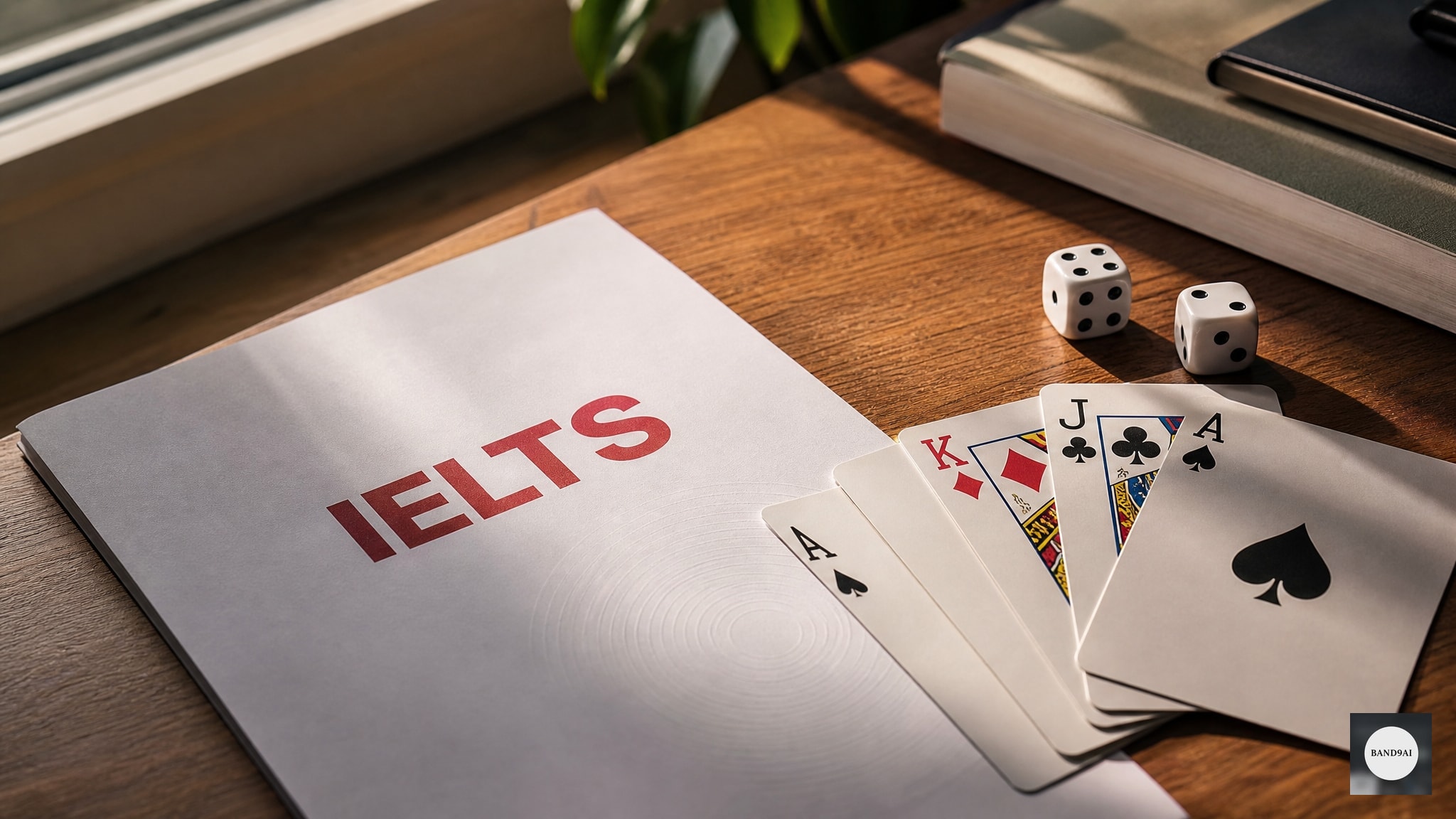
The ladder

Start at 2♠ (diagnostic) · Level up J → Q → K → A (black = Listening/Reading, red = Writing/Speaking) · Unlock Joker (complete system).

2

Not sure where you are weak?

Start with the Reality Check, a full four-skill diagnostic, then decide which Skill Fix you need.

$15

All four skills · entry diagnostic

Start here, full diagnostic

2

Payments processed by Stripe. Seller: BAND9AI HUMAN SYSTEMS INC., Toronto, Canada.

Face cards, skill fixes

J & Q are black suits (analytical: Listening & Reading). K & A are red suits (expressive: Writing & Speaking). Each tier: simulation, correction, breakdown, retakes until you improve.

J

Listening Fix

Miss it once = lose marks

$29/mo

✓ Monthly subscription · Listening

✓ Listening simulation

✓ AI correction

✓ Mistake breakdown

✓ Retake until improvement

Step 1: Fix how you hear

J

Payments processed by Stripe. Seller: BAND9AI HUMAN SYSTEMS INC., Toronto, Canada.

Q

Reading Fix

Run out of time

$29/mo

✓ Monthly subscription · Reading

✓ Reading simulation

✓ AI correction

✓ Mistake breakdown

✓ Retake until improvement

Step 2: Fix how you process

Q

Payments processed by Stripe. Seller: BAND9AI HUMAN SYSTEMS INC., Toronto, Canada.

K

Writing Fix

Stuck at 6.5

$29/mo

✓ Monthly subscription · Writing

✓ Writing simulation

✓ AI correction

✓ Mistake breakdown

✓ Retake until improvement

Step 3: Fix how you write

K

Payments processed by Stripe. Seller: BAND9AI HUMAN SYSTEMS INC., Toronto, Canada.

A

Speaking Fix

Freeze under pressure

$29/mo

✓ Monthly subscription · Speaking

✓ Speaking simulation

✓ AI correction

✓ Mistake breakdown

✓ Retake until improvement

Step 4: Perform under pressure

A

Payments processed by Stripe. Seller: BAND9AI HUMAN SYSTEMS INC., Toronto, Canada.

Most popular

Payments processed by Stripe. Seller: BAND9AI HUMAN SYSTEMS INC., Toronto, Canada.

Next Steps After Checking Your IELTS Score

Bridging the Gap Between Results and Retake Success

Spotting a specific deficit during your IELTS result check has to lead straight to targeted intervention, using precise evaluation tools rather than generic study materials. The relief of hitting your target, or the disappointment of falling short, both carry momentum that fades fast without direction. Put that energy into testing your diagnostic hypothesis before you book another official sitting.

If your analysis points to Task Response as the limiting factor, write three essays focused only on idea extension and get them evaluated against Band 7 descriptors before you go back to full-length timed tests. This kind of focused iteration builds the specific skills that move your score. Repeating full tests without targeted correction just measures the same deficit again.

Feedback from peers or unqualified tutors can't confirm whether your corrections actually match examiner expectations. You need evaluation that applies the same rubric precision as official markers, so you know your improvements are real and not imagined. Understanding how AI mirrors official marking shows why systems trained on examiner data give more reliable diagnostic validation than subjective human opinion. These systems score against fixed criteria without fatigue, bias, or inconsistency, so you can trust that your practice gains will carry over to official test conditions. Validating before you retest cuts out the expensive gamble of hoping your self-directed study hit the right target.

Your next IELTS result check should confirm progress, not repeat old errors. Treat the interval between tests as a controlled experiment: isolate each variable, test it, validate it, then move to the next. Stop guessing why you missed your target band and start using criterion-specific diagnostic feedback to engineer the outcome you want. Make your next result check confirm a solved problem, not repeat an old one.

Disclaimer: IELTS is a registered trademark of the University of Cambridge ESOL, the British Council, and IDP Education Australia. BAND9AI is an independent platform providing AI-powered IELTS mock testing and is not affiliated with, endorsed by, or connected to these organizations.